
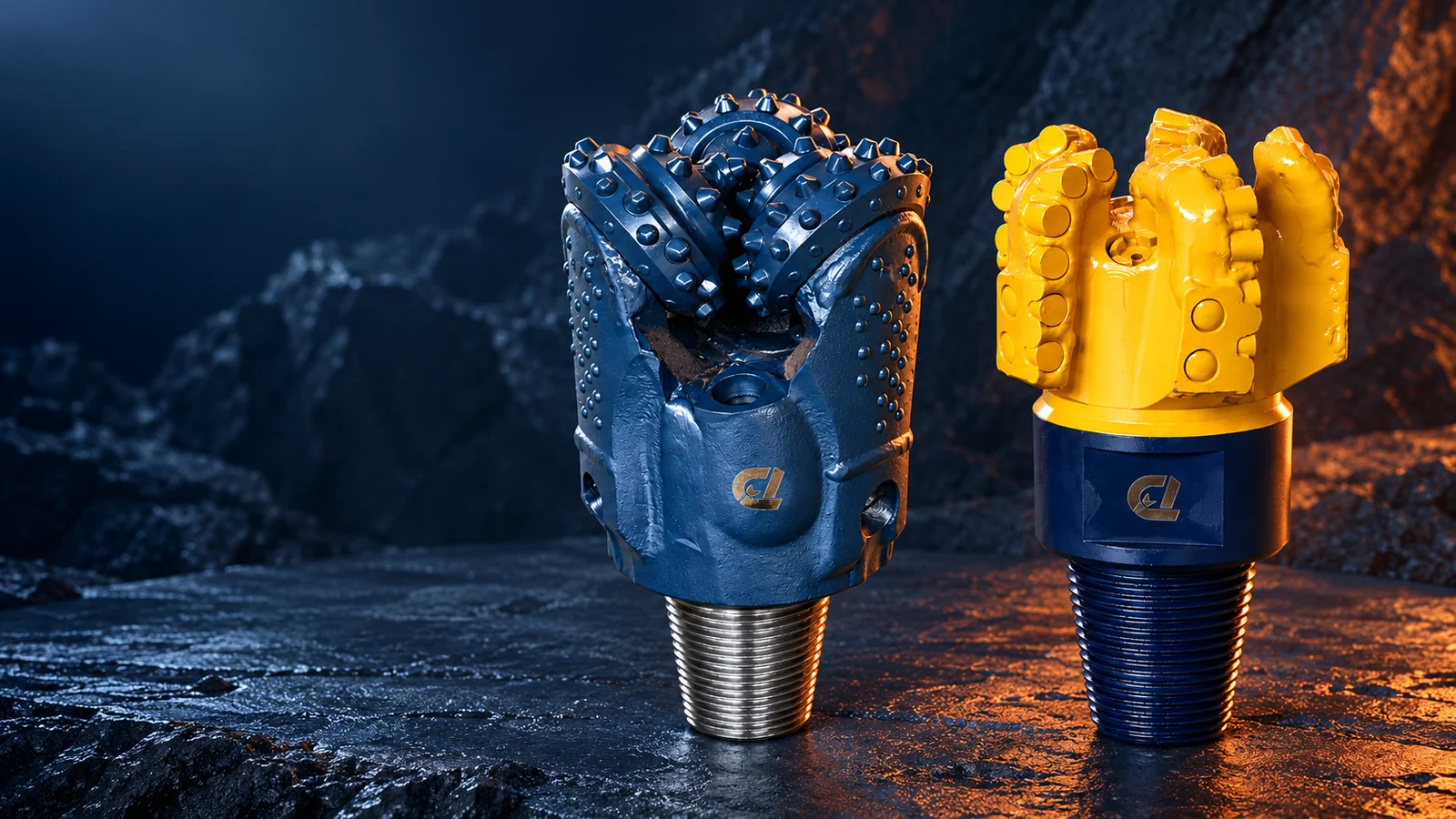
PDC bits shear rock with fixed cutters; tricone bits crush and chip rock with three rolling cones. In HDD work, PDC is commonly evaluated for competent, consolidated formations, while tricone is commonly evaluated for fractured, broken or variable rock. Neither is automatically superior. The correct choice depends on formation structure, strength, abrasivity, steering system, hydraulics and the drill’s operating envelope.
How a PDC bit cuts
A polycrystalline diamond compact bit uses fixed cutters mounted on blades. As the bit rotates, the cutters shear the rock. With stable engagement in a suitable formation, this action can produce an efficient, continuous cut.
Key design variables include:
- cutter size, grade and exposure;
- blade count and profile;
- back-rake and cutter orientation;
- gauge protection;
- body material and wear protection;
- nozzle count, position and replaceability;
- connection and overall bit geometry.
PDC selection should account for impact risk. Intermittent contact, severe vibration or broken rock can damage fixed cutters even when the intact rock strength appears suitable.
How a tricone bit cuts
A tricone bit uses three rotating cones fitted with teeth or tungsten-carbide inserts. The cones roll over the bottom, crushing and chipping the formation. This action can be useful where the face is irregular, fractured or variable.
Key design variables include:
- milled tooth or insert cutting structure;
- insert shape and projection;
- bearing and seal design;
- cone offset and geometry;
- gauge protection;
- jet placement and cleaning;
- connection and bit diameter.
The cones must rotate freely and remain properly cleaned. Bearing, seal or cone problems can quickly change drilling behavior.
Side-by-side comparison
| Question | PDC | Tricone |
|---|---|---|
| Primary cutting action | Shearing | Crushing and chipping |
| Formation starting point | Competent, consolidated rock | Fractured, broken or variable rock |
| Moving cutting parts | No rolling cones | Three rolling cones |
| Main inspection focus | Cutter edges, blades, gauge and nozzles | Cone rotation, inserts/teeth, bearings/seals, gauge and jets |
| Typical damage concern | Chipped cutters, lost gauge, erosion | Missing inserts/teeth, stalled cone, bearing/seal wear |
| Hydraulic priority | Cooling and cleaning each blade/cutter zone | Cleaning all cones and removing crushed fragments |
The table is a screening tool. It does not replace manufacturer application data or rock testing.
Five questions that make the decision clearer
1. Is the rock intact or fractured?
This is often more useful than rock name alone. Competent rock can provide consistent support for a shearing action. Broken rock can create impact and irregular loading, making a rolling/crushing action worth evaluating.
2. How abrasive is the formation?
Abrasivity affects gauge, body and cutter wear on both bit types. Ask for test data when available and inspect used tools from comparable nearby work.
3. What drilling system provides steering?
Confirm whether the project uses a conventional steerable assembly, mud motor, dual-rod system, air system or another rock-drilling method. The bit must be compatible with that system’s flow, rotation, connection and steering geometry.
4. Can the face be cleaned?
Cuttings that remain at the face are recut, increasing heat and wear. Verify pump flow, pressure, nozzle area, fluid program and expected returns. Hydraulic capacity can eliminate an otherwise plausible tool choice.
5. What does the rig data show?
Track penetration per rotation or per rod, torque, thrust, fluid pressure, vibration and steering response. A change in trend may indicate formation transition, poor cleaning or tool damage.
Inspection before and after a run
For a PDC bit, inspect every cutter, blade, gauge surface, nozzle and fluid passage. Look for chipped or missing cutter material, erosion, cracking and reduced diameter.
For a tricone, verify cone rotation and inspect teeth/inserts, gauge, shirttail or leg protection, jets, seals and evidence of bearing distress. Follow the manufacturer’s service criteria; a cone that feels abnormal should not be returned downhole without review.
For both types, clean and inspect threads and shoulders. Measure critical dimensions with appropriate tools and compare them with the approved drawing or service limit.
A better way to request a recommendation
Instead of asking only for “a hard-rock bit,” provide:
- rock type, strength and abrasivity data;
- whether the formation is intact, bedded, fractured or broken;
- bore profile and minimum radius;
- drill and rock system;
- connection and housing details;
- pilot diameter;
- pump flow and pressure;
- expected operating parameters;
- photographs of samples, cuttings and previously used bits.
This information allows the supplier to discuss cutter structure, body protection and hydraulic configuration rather than recommending from diameter alone.
Frequently asked questions
Does a PDC bit drill faster than a tricone?
Not in every formation. Penetration depends on rock structure, strength, abrasivity, cutter design, hydraulics, operating parameters and the drilling system. A fast bit in the wrong formation can also wear or fail quickly.
Is tricone only for soft rock?
No. Tricone cutting structures are available for a range of formations. In HDD selection, rolling cones are often considered for fractured or broken rock because of their crushing action and ability to engage an irregular face.
Does a PDC bit have bearings?
The fixed-blade PDC cutting structure has no rolling cones and therefore no cone bearings. The complete drilling assembly may contain other moving or serviceable components.
Can the same connection be used for both bits?
Only if the verified thread, orientation, shoulder and assembly requirements match. Never assume interchangeability from nominal diameter.
References and further reading
- Vermeer: Tooling for fractured and solid rock
- Vermeer: Picking tooling for rock bores
- Ditch Witch HDD parts book
Suggested internal CTA: Compare available PDC and tricone configurations after submitting your formation and drill-system data.