
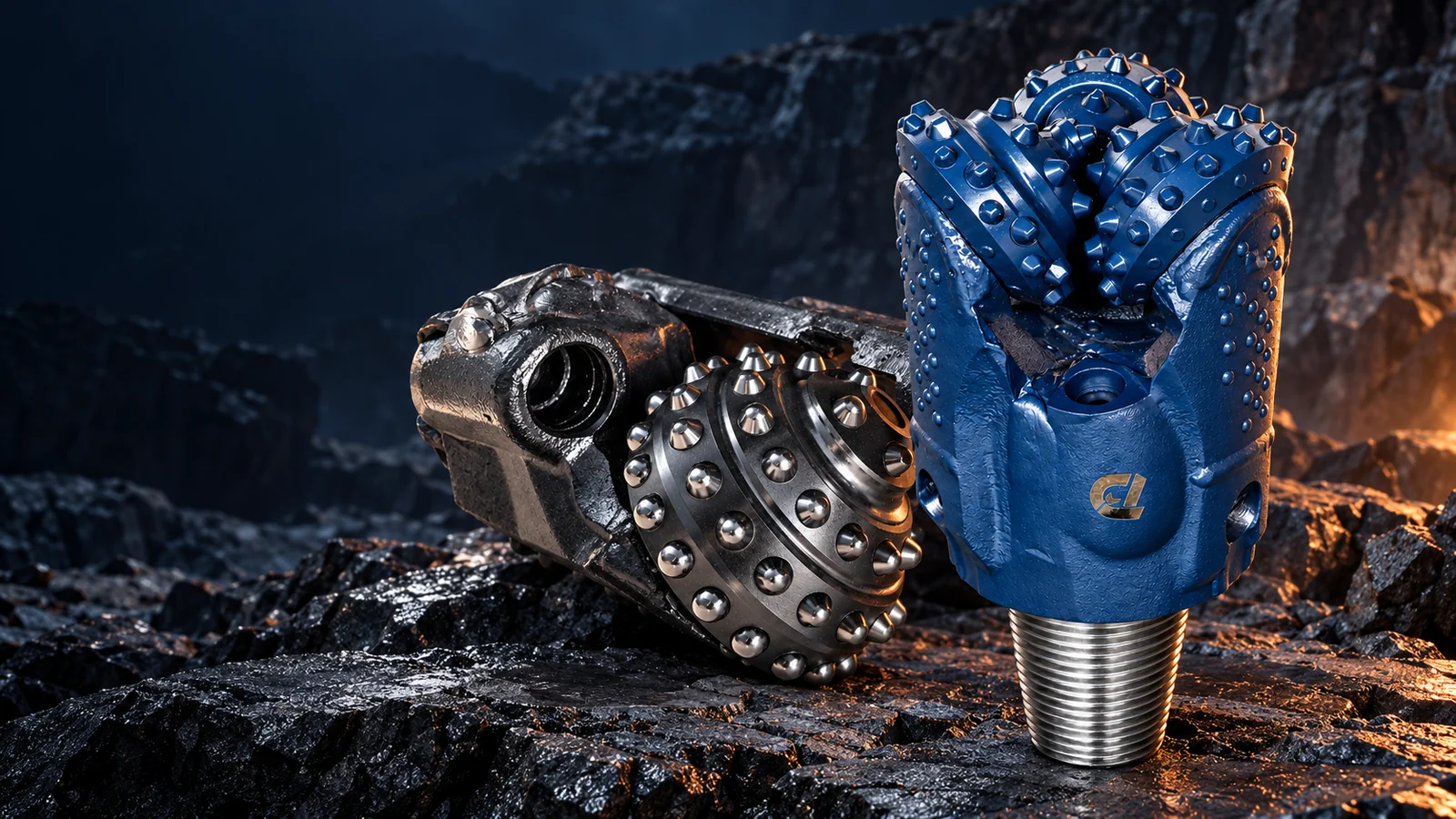
The short answer: choose hard-rock HDD tooling from the rock structure, strength, abrasivity and bore plan—not from the word “rock” alone. A tricone is often considered for fractured, broken or variable rock because its rolling cones crush and engage an irregular face. A PDC bit is often considered for competent, consolidated formations where a stable shearing action can be maintained. The final decision must also fit the drill system, steering method, connection, hydraulic capacity and required bore diameter.
That distinction is a starting point, not a universal rule. A representative rock sample and an experienced tooling review are more valuable than selecting from appearance alone.
Start by describing the rock correctly
“Hard rock” can describe very different downhole conditions. Before choosing a pilot bit or hole opener, document:
- whether the formation is competent, bedded, fractured, broken or interbedded;
- rock type and any visible changes along the planned alignment;
- unconfined compressive strength when test data is available;
- abrasivity, silica content or observed cutter wear from nearby work;
- groundwater, voids and potential loss zones;
- bore length, bend radius, entry and exit geometry;
- required pilot diameter and final product diameter.
Two formations with similar strength can behave differently if one is intact and the other is fractured. Vermeer’s rock-tooling guidance similarly separates solid rock from fractured or broken formations when discussing tool choice. This is why “granite” or “limestone” by itself is not a complete tooling specification.
PDC or tricone for the pilot bore?
| Decision factor | PDC pilot bit | Tricone pilot bit |
|---|---|---|
| Cutting action | Fixed cutters shear the formation | Rolling cones crush and chip the formation |
| Common starting point | Competent, consolidated rock | Fractured, broken or variable rock |
| Formation stability | Benefits from consistent engagement | Can accommodate an irregular rock face |
| Wear review | Check cutter edges, gauge area and body protection | Check inserts or teeth, cone rotation, bearings/seals and gauge |
| Hydraulic review | Confirm nozzle layout, cooling and cuttings removal | Confirm cleaning around all cones and removal of crushed cuttings |
PDC does not automatically mean “harder rock,” and tricone does not automatically mean “softer rock.” The more useful question is: which cutting action can remain stable and clean the face in this specific formation?
For a PDC option, review cutter grade, blade count, cutter exposure, gauge protection, nozzle arrangement and body style. For a tricone, review insert or tooth type, bearing/seal design, cone geometry, gauge protection and jet placement. These details should be confirmed against the supplier’s application data rather than inferred from product diameter alone.
Select the enlargement tool separately
The pilot tool and enlargement tool do different jobs. A successful pilot does not prove that the same cutting concept is appropriate for every reaming pass.
For rock enlargement, common categories include:
- roller-cone hole openers, which use replaceable or serviceable rolling cutters to crush rock;
- PDC hole openers or reamers, which use fixed cutters to shear competent formations;
- application-specific staged assemblies, selected when torque, cuttings transport or bore stability makes one large pass unsuitable.
Confirm the cutter arrangement, replaceability, gauge protection, body strength, fluid ports, connection and allowable operating envelope. The planned pass diameter must remain within the drill rig’s practical torque, thrust/pullback and fluid-delivery capability.
Hydraulics are part of the tool choice
Rock cuttings must be removed from the face and transported through the annulus. Insufficient cleaning can cause recutting, heat, rapid wear, high torque and poor progress even when the cutter type is correct.
The fluid program should be designed for the actual geology and bore geometry. Review pump capacity, nozzle area, annular velocity, fluid properties, returns and disposal constraints with the project’s drilling-fluid specialist. Tool cooling and face cleaning are especially important in abrasive formations. Do not change nozzle sizes or fluid rates without checking the tool and rig manufacturer’s limits.
Confirm compatibility before ordering
An application review should record:
- drill make and model;
- drill-pipe size and connection;
- pilot assembly or rock-drilling system;
- available rotary torque, thrust and pullback;
- pump flow and pressure range;
- minimum bend radius and steering requirement;
- pilot and enlargement diameters;
- expected formation intervals;
- planned reaming sequence;
- product pipe and pullback assembly.
Connection names should never be assumed from nominal diameter. Confirm thread standard, pin/box orientation, shoulder condition, makeup procedure and any required adapter from drawings or verified measurements.
Monitor the first rods and first pass
Tool selection continues after the tool enters the ground. Establish baseline operating data and watch for changes in:
- torque and thrust/pullback;
- penetration rate;
- vibration and steering response;
- fluid pressure, flow and returns;
- cuttings size and character;
- gauge wear, cutter damage and connection wear.
Stop and investigate unexplained trends rather than compensating indefinitely with more force. Excessive pressure or torque may indicate poor cleaning, an unsuitable cutting structure, changing geology or a damaged assembly.
Practical selection checklist
- Obtain the best available geotechnical information and a representative sample.
- Classify the formation as competent, fractured, broken or mixed.
- Compare shearing and rolling/crushing cutting actions.
- Confirm the rig, steering system, connection and hydraulics.
- Plan the enlargement sequence rather than selecting only the final diameter.
- Inspect gauge, cutters, cones, nozzles and threads before every run.
- Record performance by formation interval to improve the next selection.
Frequently asked questions
Is a PDC bit always the best choice for hard rock?
No. PDC bits are commonly considered for competent, consolidated formations, but cutter design, rock strength, abrasivity, drilling system and hydraulics all matter. Fractured or broken rock may favor a rolling-cone approach.
When should an HDD contractor consider a tricone bit?
A tricone is often evaluated for fractured, broken or variable rock where rolling cones can crush and conform to an uneven face. The bearing, seal, insert and gauge configuration still needs to match the application.
Can one hole opener make the final diameter in a single pass?
Sometimes, but not automatically. Large step-ups can exceed available torque or cleaning capacity and may reduce bore stability. The bore design, rig capacity, geology and product specification determine whether staged enlargement is appropriate.
What information should be sent for a tooling recommendation?
Send the bore profile, ground report or sample information, pilot and final diameters, drill model, pipe and connection, pump capacity, planned steering system and any performance data from previous bores.
References and further reading
- Vermeer: Picking the right tooling for rock bores
- Vermeer: Be prepared with the right tooling when you drill in rock
- Ditch Witch: Backreamers and rock hole openers
Suggested internal CTA: Request a technical tool review with the bore diameter, rock description, drill model and connection requirement.